
Collections and CMS
Dynamic pages, bindings, fields, and taxonomy.
Collections power structured content: blog posts, services, products, team members, locations, resources, events, and any repeated data that should not be hand-built page by page.
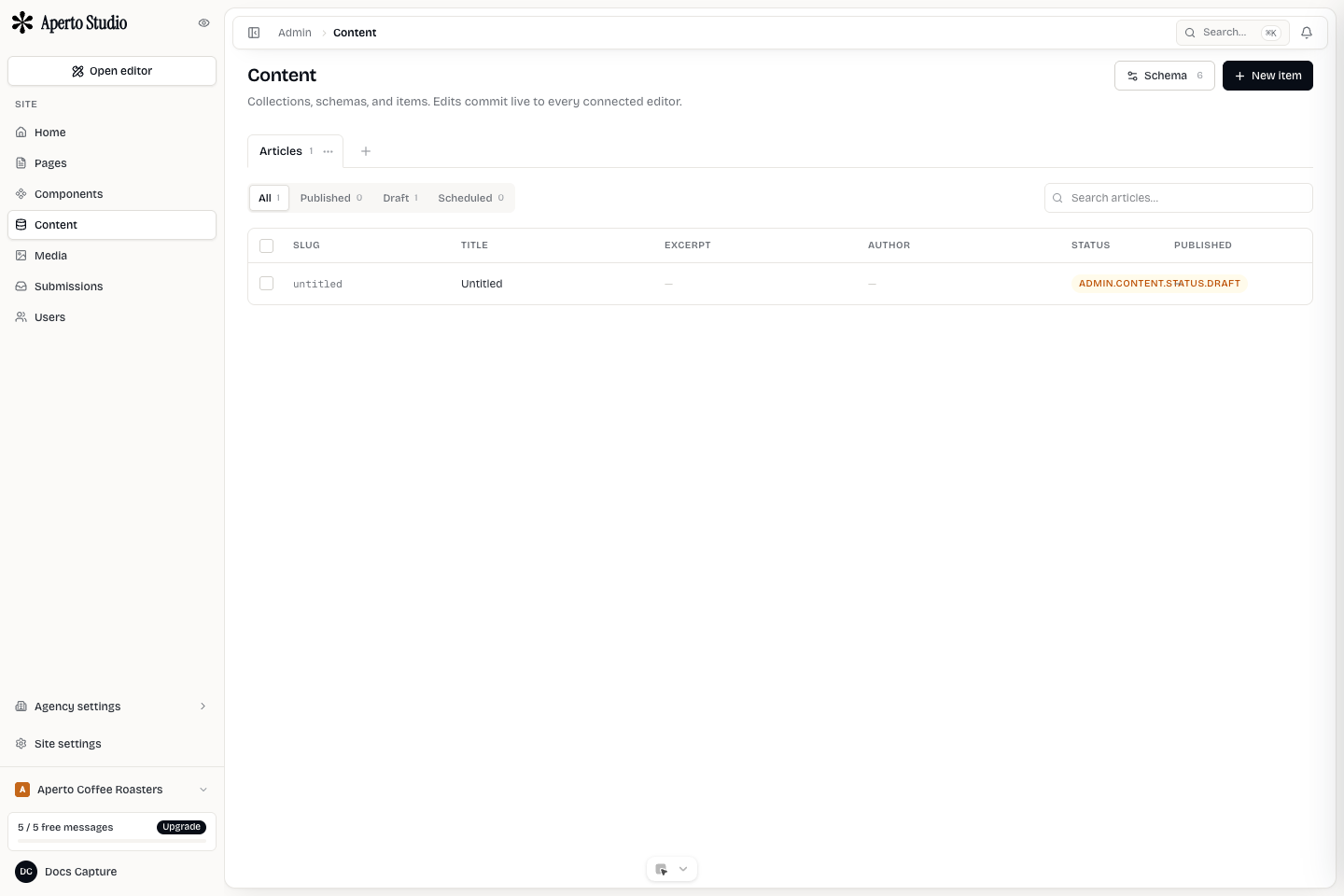
Collections
A collection is a content type. It has fields and items. For example, a Posts collection might include title, slug, excerpt, cover image, author, published date, category, and body. Each post is an item in that collection.
Create a collection when the client will add or update many similar entries. Do not create separate pages for every post or product unless the content is truly static.
Fields
Fields define the shape of each item. Pick field names that editors understand. A clear schema is easier for humans and AI agents to use.
Common field types include:
- Short text for titles, labels, and names.
- Long text for descriptions or article bodies.
- Image fields for covers, avatars, or product images.
- Date fields for publishing or events.
- Select-like fields for status or category.
- Slug fields for route segments.
Listing pages
A listing page shows many items from a collection. Examples: all posts, all services, all products, or a team directory. In the editor, a repeated card can bind to collection fields with tokens such as {{title}}, {{coverImage}}, and {{@url}}.
Keep listing cards concise. They should help visitors choose an item, not replace the single-item page.
Single-item templates
A single-item template renders one item at a route such as /posts/my-post. The template uses the same fields, but it shows the full content. The renderer resolves the item from the route and fills the tokens for that item.
Before publishing a CMS section, test at least two items. A template that only works for one item may have fixed copy or a hard-coded image left behind.
Taxonomy
Use taxonomy when visitors need to filter or browse grouped content. Categories, tags, regions, service types, and product families are common examples. Keep taxonomy shallow unless the site truly needs more depth.